Friday, June 12, 2009

Botanical Gardens

The other day we went to the Botanical Gardens after class, where we took a long walk among the very green garden since most of the flowers are out of season and finished blooming. However, it was still pretty and serene walking though it.

As we were getting ready to head out, we stumbled upon a fountain which had not had the best upkeep. It reminded me of many other fountains in the city. The Trevi Fountain and the Fountain of the Four Rivers and all the other well known fontanas are mostly always clean and ready for pictures. But many of the other fountains around Rome are so small, unknown, and old that they don't seem to warrant as much attention.

I think this is part of the appeal of the fountains of Rome. If one wanted to see a prefectly white, gleaming piece of art than one could just look in a book. However, seeing the fountains which have aged and weathered ages Rome and reminds us that it isn't today how the city once was.

Cittá dei Ragazzi

Instead of having a discussion in class today, we took a field trip about a half an hour outside of the city. We took the public buses, which led us to Cittá dei Regazzi, or Boys' Town. Boys' Town of Italy is a place which houses close to 60 orphaned boys from countries all over the world. It was founded in 1945 by Monsignor John Patrick Carroll-Abbing, an Irish priest in the Vatican Diplomatic Services. It became incorporated in 1951 and is recognized as an American Charity with service abroad.

It was a really interesting place to go; it's sort of like a city within a city, but the boys run where they live. The orphans are responsible for certain chores, such as cleaning their rooms and keeping the main road clean, and also for governing themselves, running the kitchens and shops and keeping themselves organized. The boys go to school and also learn to work with computeres, ceramics, glass, etc.

While we we getting a tour, we met with the mayor of Boys' Town, a 17-year-old from Afghanistan who had been living in the community for two years. He was elected by his peers for a term of two months. Once elected, the mayor gets to choose his cabinet as well. The mayor explained in Italian some of how thier government worked and we got a pretty good translation and picture from our tourguide.

Even though it was extremely hot walking from building to building, I really enjoyed going to see Boys' Town. I think it's a great place for kids to come and learn responsibility and still be able to have fun. It gives them a chance to interact with other young men from similar backgrounds and gives them a chance at a better life than what they most likely would have had.

1. Boys' Towns of Italy, Inc. 14 June 2009 .


Fontana in Firenze

Last weekend we took a trip to Florence to get a look at another major city in Italy. After traveling all day through Siena and finally to Florence, we were pretty tired. We showered and ate dinner and proceeded to share a bottle of wine, but then we split up. Joe, Jackie, and I took to walking around the city since we didn't feel like going back to the hostel just yet. Somehow we ended up in Piazza della Signora staring up at all the statues strewn around us, including a replica of Michelangelo's David.

Right next to Palazzo Vecchio is the Fountain of Neptune. It was created by Bartolomeo Ammanatti in 1565 for the wedding of Franceso I de' Medici to the grand duchess Johanna of Austria. The face of Neptune apparently resembles that of Cosimo de' Medici and the entire foutain is supposed to be "an allusion to the dominion of Florentines over the sea."

It is a pretty fountain, but oftentimes these pieces make me scratch my head. This one in particular made me wonder, because it seems as if a child is right under Neptune's naked body. If one looks closely, the child looks to be handing something to Neptune, but I am still unaware of the significance of it and why it had to be carved into the precious marble.

1. "Palazzo Vecchio." The Museums of Florence. 14 June 2009 .

Tuesday, June 9, 2009

Living in Navona.

Some of our friends in the Architectural Engineering program were fortunate enough to be assigned the apartments overlooking Piazza Navona. I have no idea how this happened. All I know is I'm a little bit jealous. The AE kids get to look down on a beautiful piazza bustling with activity for the same price every had to pay, even those living far off in Trastevere.

People can rent the apartment fitted around the outside of the piazza, but the prices can get pretty steep. However, if I were ever to somehow someway make enough money, when I come back I would definitely look into staying in a place like this.

Thursday, June 4, 2009

Domus Flavia

High up on Palatine Hill is where many of Rome's most famous characters lived. The best preserved buildings are the House of Augustus and the House of Livia, his wife. Apparently, Augustus lived a frugal life but the following emperors disregarded his example and created extravagant lifestyles for themselves and their families. The extensive ruins are those built by Domitian, Domus Augustana and Domus Flavia, the two wings of his palace.

When we walked throughout Palatine, being able to identify the ruins helped a lot when seeing them, as opposed to just standing there looking at really old buildings. Two unique things that are part of the ruins are fountains contained in the Domus Flavia, the official wing of the palace. One is in the shape of an oval, located in a spot where it could easily be seen from the dining hall of the palace. Up close, it actually reminds me of a ship for some reason, but one can definitely tell it could have been a source of beauty. On the other hand, one wouldn't know that the octagonal fountain in the courtyard was a fountain, just by looking at it today. It seems very shallow and not what one would expect.
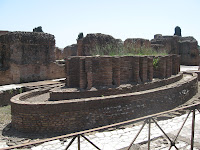
Seeing the dried up fountains reaffirms the fact that they have been part of the aesthetics of Rome for centuries, not just the more recent creations like the Trevi Fountain or the Fountain of the Four Rivers.

1. Publishing, DK. Rome (Eyewitness Travel Guides). New York: DK Travel, 2006.

Protestant Cemetery

We held class outside the Sede today, and on the agenda was the Aventine Hill area. We went to the top of the hill and got a beautiful view of the city, the Roseto Comunale - a rose garden in the shape of a menorah because it was built over an old Jewish graveyard, and the Knights of Malta priory, which has a keyhole that shows a miniature view of St. Peter's dome lined by trees. All of these were beautiful and definitely worth the walking, and I don't think I would have ever seen these had it not been for our class.


But the first thing we stopped at was really interesting. Right across from the Piramide Metro station is the Protestant Cemetery, where centuries of non-Catholics have been buried. Walking through the cemetery is a very peaceful experience, with birds chirping and room to walk along all of the numbered rows, housing hundreds of headstones. Cats are everywhere; the cemetery is yet another cat sanctuary in Rome, the other being right near Campo de' Fiori. Many of the epitaphs tell of people who were born elsewhere but came to Rome and wanted to rest forever here. I really liked this quote from Longfellow, which pretty much sums up many people's feeling about the city:

"There is the centre to which all gravitates
One finds no rest elsewhere than here.

There may be other cities that please us for a while,

but Rome alone completely satisfies.

It becomes to all a second native land by predilection,

and not by accident of birth alone.
"

The old cemetery is right next to the new one, but it doesn't hold nearly as many graves in the shadow of the Pyramid that is the memorial to Caius Cestius. It's path weaves in a distorted circle around a central grassy area, and in the upper left hand area is the grave of famed English poet John Keats, whose epitaph reads "Here lies OneWhose Name was writ in Water."

We got to spend about thirty minutes walking throughout the damp grass of the cemetery, and it made me really appreciate my family and the life I get to live everyday.

1. Publishing, DK. Rome (Eyewitness Travel Guides). New York: DK Travel, 2006.

Wednesday, June 3, 2009

Gotcha!

Today, I decided to just relax and do some people watching in Piazza Navona. I grabbed a panini and strolled through the artwork displayed in the center, constantly amazed at how beautiful these handmade creations were.

When I first walked into the Piazza, there was a noticeable quiet-the water from Il Fontana dei Quattro Fiumi was absent, and the fountain dried up. I'm still wondering why this was; maybe it was time for a cleaning? However, it didn't tear at me too much so I neglected to ask anyone. Instead, I took a seat on a bench and enjoyed the beautiful weather and crowds of people.

Naturally, there were some peddlers around offering sun umbrellas and hats. One such man didn't forsee what he got today; two policemen taking him in, most likely for a fine. Watching the scene play out was actually pretty comical. At first, he ran away and just went to the other side of the piazza. His mistake was to just take a seat right there, for the officers saw him and decided to stalk him like prey until they jumped behind him. All I know was that afterwards they walked him somewhere, and when they were walking back he had none of the goodies he was hawking earlier.

In our three weeks of being here, that was the first time I have seen a peddler get any kind of reercussion for their actions. I guess the polizia were just trying to keep the beautiul piazza free of any kind of blemishes.